






 Platform
Aug 24, 2026 • 10 min read
The Complete Guide to Lighting: How to Reduce Energy Use, Lower Electricity Costs, and Improve Your Home

Home lighting choices, including bulb type, placement, and duration of use, affect electricity costs, comfort, mood, and overall well-being.
According to the Energy Information Administration’s 2020 Residential Energy Consumption Survey (RECS), lighting accounts for about 5% of total energy costs for the average US home. If we translate that to the average US electricity prices from the end of 2025, we’re looking at over $120 per year spent on lighting energy use for the average US home. Many homes still contain outdated lighting technology, inefficient light fixture layouts, or improper brightness levels, which can in turn cause these figures to be much higher.
The good news is that lighting is one of the easiest and most affordable parts of a home to improve. Switching to LEDs, turning off lights when not in use, using natural daylight, and placing light strategically can reduce electricity use while making your home more functional and comfortable.
This guide covers everything you need to know about lighting technology, energy use, bulb costs, lighting design, shopping for bulbs, and creating healthier lighting habits.
Table of Contents
Why Understanding Your Home’s Lighting Matters
Understanding how your home uses lighting can help you identify ways to lower your energy bills while improving the quality and comfort of your living spaces.
Lighting refers to the technology used to illuminate the inside and outside of a home. Most homes use two main layers of lighting:
- Ambient lighting, which provides general illumination throughout a room
- Task lighting, which supports specific activities such as reading, cooking, or working
A light bulb is the replaceable component that converts electricity into visible light. A light fixture is the structure that holds and powers the bulb, such as a ceiling light, lamp, or wall sconce.
The technology inside a bulb determines how much electricity it uses, how bright it is, how long it lasts, and how much it costs over time. Lighting design and daily habits also affect total energy use. A home can have efficient bulbs and still waste electricity if lights are poorly placed or regularly left on when they are not needed.
Improving your lighting requires considering not only lighting technology, but also placement, brightness, room characteristics, and behavior.
What Are the Main Types of Light Bulbs?
The three common types of lighting technology found in homes are light-emitting diodes (LEDs), compact fluorescent lamps (CFLs), and incandescent bulbs.
Light-Emitting Diodes (LEDs)
Light-emitting diodes, or LEDs, are the recommended lighting technology for household use because they combine low electricity consumption with long lifespans.
A standard LED bulb uses approximately 5 to 12 watts, can last more than 25,000 hours, and has a capital cost typically between $2 and $8.
Although LEDs can have a higher upfront purchase price than some incandescent or CFL bulbs, their lower energy use and longer lifespans make them the most cost-effective choice over time.
LED adoption has increased rapidly, as 37% of homes used all LEDs in 2024, up from 21% in 2020. Approximately 90% of homes reported using at least some LEDs in 2024.
Compact Fluorescent Lamps (CFLs)
Compact fluorescent lamps, or CFLs, use less electricity and last longer than incandescent bulbs, but they are generally less efficient and shorter-lived than LEDs.
A standard CFL uses approximately 9 to 23 watts, lasts between 8,000 and 15,000 hours, and typically costs between $2 and $3 upfront.
Approximately 45% of US homes reported having at least a few CFLs in use in 2024.
CFLs also contain small amounts of mercury. They should be handled carefully and properly recycled rather than placed in household trash.
Incandescent Bulbs
Incandescent bulbs are the oldest and least efficient of the three common household lighting technologies.
A standard incandescent bulb uses approximately 40 to 100 watts, lasts between 1,000 and 2,000 hours, and typically costs between $1 and $3 upfront.
Although incandescent bulbs may have a low purchase price, their high electricity use and short lifespans make them the most expensive option over time.
In 2024, 1 out of every 20 homes still used all incandescent bulbs, and 51% of homes reported having at least a few incandescent bulbs. That was an improvement from 2020, when 61% of homes still reported using at least some incandescent bulbs.
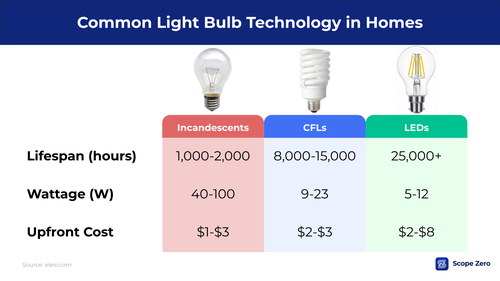
Overall, LEDs generally offer the lowest energy use and longest lifespan.
To learn more about each bulb type and determine which option is right for your home, read our blog post, LED vs. CFL vs. Incandescent Bulbs: Which Is Best for Your Home?
How Much Does Home Lighting Cost?
The total cost of a light bulb over its lifetime includes both the upfront price of the bulb and the electricity required to operate it.
In 2020, lighting represented approximately 5% of the average US home’s total energy costs, or about $92 per year. At 2025 electricity rates, the estimated average was closer to $120 per year.
A household’s actual lighting costs depend on:
- Local electricity rates
- The number of bulbs in the home
- Each bulb’s wattage
- How many hours the bulbs are used
- How frequently bulbs must be replaced
Daily usage patterns can make a significant difference. On average, US households reported keeping:
- ~6 bulbs on for one to four hours per day
- ~4 bulbs on for four to eight hours per day
- ~2 bulbs on for more than eight hours per day
Approximately 40% of homes also reported leaving at least one outdoor light on throughout the night, every night.
To learn more about what determines household lighting costs and how much switching to LEDs could save, read our blog: How Much Does Home Lighting Cost, and How Much Can LEDs Save?
How Do You Calculate a Light Bulb’s Electricity Cost?
To understand the cost of operating a light bulb, begin by multiplying its wattage by the number of hours it is used. For example, a 60-watt incandescent bulb used for five hours per day consumes:
60 watts × 5 hours = 300 watt-hours per day
That is equal to 0.3 kilowatt-hours, or kWh, per day. At an electricity rate of $0.20 per kWh, that bulb costs approximately $0.06 per day, or about $22 per year.
Replacing it with a 9-watt LED that performs a similar function would reduce the annual operating cost to just over $3.
That is an approximately 85% decrease in operating costs for a single frequently used light bulb.
How to Shop for Light Bulbs
When shopping for light bulbs, consider four main factors: shape, brightness, color, and features.
Bulb Shape and Base Type
Bulbs come in different shapes and sizes. Their labels usually combine letters and numbers, such as A19 or BR30.
The letter identifies the general shape. Common examples include:
- A: A classic pear-shaped household bulb
- BR: A bulged reflector bulb often used in recessed lighting
- C: A candle-style bulb commonly used in decorative fixtures
- G: A globe-shaped bulb frequently used in bathroom vanities
The number describes its size in eighths of an inch. For example, an A19 bulb has a diameter of 19/8 inches.
Base labels also use letters and numbers. E26 is the most common base in the United States. The “E” refers to an Edison screw, while “26” represents the base’s diameter in millimeters.
Other common bases include E12 candelabra bases and specialty connections such as GU10 or bi-pin bases.
The easiest way to find a compatible size for a light bulb replacement is usually to check the code printed on the existing bulb or the information listed on the fixture.
Brightness
Brightness is measured in lumens, not watts.
Watts measure electricity use, while lumens measure how much visible light a bulb produces. A 9-watt LED can provide approximately the same brightness as a 60-watt incandescent bulb because LED technology produces light more efficiently.
A standard A19 60-watt incandescent bulb produces about 800 lumens. When an LED package says “60-watt equivalent,” it means the LED produces a similar level of brightness, not that it consumes 60 watts.
Task-oriented rooms such as kitchens and workspaces usually need more lumens per square foot. Bedrooms and living rooms can often use lower, softer light levels.
Focusing on lumens helps you choose the brightness you need without unnecessarily increasing electricity use.
Color Temperature
Color temperature describes how warm or cool a light appears and is measured in Kelvin, or K.
- Around 2700K produces a warm, soft, yellow-toned light
- Around 4000K to 5000K produces a cooler, blue-white, daylight-like appearance
Warmer light generally works well in areas intended for relaxation, such as bedrooms and living rooms. Cooler light may be better suited to task-oriented spaces such as kitchens, bathrooms, and home offices.
Additional Features
Dimmable bulbs allow you to adjust brightness based on the activity or time of day. However, the bulb must be labeled as dimmable and used with a compatible dimmer switch.
Smart bulbs can be controlled remotely, scheduled, or programmed to change brightness and color. However, smart functions also require energy. If household members already turn lights off consistently when they are not being used, smart bulb technology may not be necessary.
How to Reduce Lighting Energy Use
The most effective ways to reduce lighting energy use are to choose efficient bulbs, turn off lights when not in use, use the appropriate brightness, and take advantage of natural light.
Switch to LED Bulbs
Replacing frequently used incandescent bulbs with LEDs can substantially reduce electricity use and long-term replacement costs.
A 9-watt LED performing a similar function to a 60-watt incandescent can reduce that bulb’s annual operating cost by approximately 85%.
Turn Off Lights When They Are Not Needed
Lights are often left on in empty rooms because of habit or convenience. Turning off lights in spaces that are not being used reduces electricity consumption without affecting comfort.
Use the Right Amount of Light
Not every activity requires full brightness. Using task lighting or dimming lights when possible can reduce energy demand while creating a more comfortable environment.
Take Advantage of Natural Light
Opening blinds and positioning workspaces near windows can reduce the need for electric lighting during the day.
Natural light can also support mood, productivity, and the body’s sleep-wake cycle.
Consider Timers and Sensors
Timers, motion sensors, and smart lighting systems can help turn lights off when they are not needed. These tools may be especially useful in hallways and outdoor areas where lights are more likely to be left on unintentionally.
Frequently Asked Questions
What is the most energy-efficient type of light bulb?
LEDs are generally the most energy-efficient and cost-effective choice for household lighting. A standard LED typically uses 5 to 12 watts and can last more than 25,000 hours.
How much does the average household spend on lighting?
Lighting cost the average US home approximately $92 in energy expenses in 2020. At 2025 electricity rates, the estimated average was closer to $120 per year.
How much can switching to an LED save?
Replacing a 60-watt incandescent used five hours per day with a 9-watt LED performing a similar function can reduce annual operating costs from approximately $22 to just over $3 (an approximately 85% decrease).
Are watts a measure of brightness?
No. Watts measure electricity consumption, while lumens measure brightness. A lower-wattage LED can provide the same number of lumens as a much higher-wattage incandescent bulb.
What color temperature should I choose?
Warmer light around 2700K generally works well in bedrooms and living rooms. Cooler light between 4000K and 5000K may be more appropriate for kitchens, bathrooms, and workspaces.
Do smart bulbs always save energy?
Not necessarily. Smart bulbs can help reduce how often lights are kept on with schedules and automation, but their smart features also require energy. They may be most helpful in places where lights are frequently left on unintentionally.
What is the easiest way to reduce lighting energy use?
Switching to LEDs and turning off lights in empty rooms are two of the simplest ways to reduce lighting electricity use. Using natural light and task lighting can create additional savings.
Key Takeaways
- Lighting accounted for approximately 5% of the average US home’s energy costs in 2020.
- At 2025 electricity rates, average household lighting energy costs were estimated at approximately $120 per year.
- LEDs generally use 5 to 12 watts and can last more than 25,000 hours.
- CFLs typically use 9 to 23 watts and last between 8,000 and 15,000 hours.
- Incandescent bulbs typically use 40 to 100 watts and last between 1,000 and 2,000 hours.
- Replacing a frequently used 60-watt incandescent with a 9-watt LED can reduce its operating cost by approximately 85%.
- Brightness is measured in lumens, while power consumption is measured in watts.
- Bulb shape, base type, brightness, color temperature, and additional features should all be considered when shopping for new light bulbs.
- Strategic placement, task lighting, reflective surfaces, and natural light can reduce the number of bulbs needed.
- Turning lights off, dimming when possible, and using timers or sensors can lower electricity use.
- Lighting can affect sleep, eye comfort, mood, alertness, and productivity.
Keep Learning With Scope Zero
Sign up for CSA for Individuals to access more resources that can help you save money on utility bills and reduce your environmental impact.
Interested in making the CSA available through your workplace? HR and sustainability leaders can request a demo, and employees can use our email templates to share information about the CSA with their HR team.
Join our community
Sign up for our newsletter to stay up-to-date on all things Scope Zero.


Subscribe to our newsletter



Solutions