Section 6. How population density influences transportation
Where you live has a major influence on how you travel. Population density affects the practicality of different transportation options and the type of infrastructure communities need to support daily travel.
Areas with low population density
In areas with low population density, homes, workplaces, schools, and stores are often spread far apart. Because destinations are farther away, people in these areas tend to rely heavily on cars to travel from place to place.
Walking or biking between destinations can be difficult when distances are long and infrastructure such as sidewalks or bike lanes may be limited. Public transportation can also be harder to provide in low-density areas because fewer people live within a given area. This means buses or trains would serve fewer riders while still requiring significant investment in vehicles, drivers, and infrastructure.
Areas with high population density
In areas with higher population density, many people live and work closer together. Shorter distances between homes, workplaces, and services can make walking and biking more practical options for everyday trips.
Public transportation also tends to work more effectively in higher-density areas. When many people live along the same routes, buses, trains, and subways can serve large numbers of passengers efficiently.
At the same time, driving in dense areas can present challenges. Traffic congestion, limited road space, and the difficulty of finding parking can make car ownership less convenient or more expensive.
New York City vs Vermont example
The influence of population density on transportation methods and their environmental impact can be illustrated by comparing New York City and Vermont.
About 1 in 50 people in the US lives in New York City, which has a population of roughly 8.3 million people living within a relatively small geographic area. Because so many people live close together, the city can support extensive public transportation systems, as well as walking and biking for many daily trips.
If those same 8.3 million people were spread out at the population density of Vermont, they would require a dramatically larger amount of land. In fact, accommodating that population at Vermont’s density would require an area roughly the size of Maine, New Hampshire, Massachusetts, Connecticut, Rhode Island, Delaware, New Jersey, and Maryland, along with portions of New York state. See Figure 2 below.
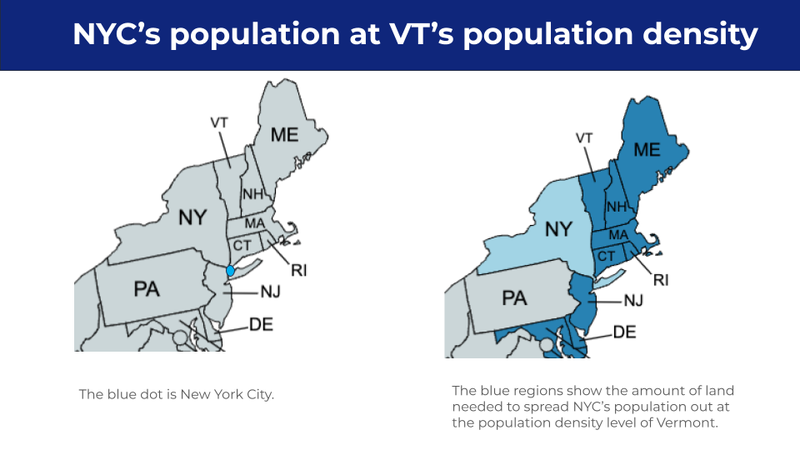
Figure 2: How much land would be needed to distribute NYC's population of 8.3 million people at Vermont's population density level.
Spreading NYC’s population across a much larger area would require significantly more roads, parking lots, utilities, schools, hospitals, and other infrastructure. It would also increase reliance on personal vehicles, because destinations would be farther apart and public transportation would be less practical to operate.