Section 3. The cost of car ownership
Because cars can be so expensive, understanding the full cost of car ownership is important in evaluating transportation choices. While many people focus on the cost of fuel, the total cost of owning and operating a car includes many different expenses that come in the form of both money and time.
Money: Gas-powered cars
Owning and operating a car involves a wide range of financial costs. These expenses include fuel, car payments, insurance, maintenance, repairs, taxes, registration fees, parking, tolls, and traffic tickets. When all of these costs are combined, the total cost of car ownership in the US often reaches around $12,000 per year, depending on the vehicle and driving habits.
Fuel is one of the most visible and variable costs of driving. The amount drivers spend on fuel depends on how much they drive, the fuel efficiency of their vehicle, and local gasoline prices.
For example, the average US driver travels about 13,500 miles per year. For a car that averages 25 miles per gallon, this means using about 540 gallons of gasoline each year.
If gasoline costs $3.50 per gallon, the annual fuel cost would be about $1,890 per year. If gasoline costs $5.50 per gallon, the annual cost increases to about $2,970 per year.
Gasoline prices vary widely across the country. Figure 1 below shows a snapshot from the American Automobile Association of average fuel prices in each state as of March 11, 2026. See here for current prices.
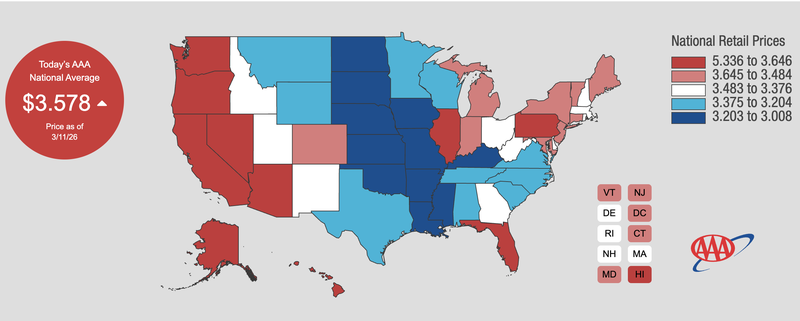
Figure 1: Average US gas prices per gallon on March 11, 2026.
Fuel costs for electric-powered cars
Electric vehicles (EVs) use electricity instead of gasoline. Instead of measuring fuel efficiency in miles per gallon, electric vehicles measure efficiency in kilowatt-hours per mile (kWh/mi) or miles per kilowatt-hour (mi/kWh).
Many modern electric vehicles use about 0.35 kWh of electricity per mile, depending on the vehicle type, driving conditions, and weather. For example, a vehicle that uses 0.35 kWh per mile and travels the average 13,500 miles per year would use about 4,725 kWh of electricity per year.
The total cost of driving an electric vehicle depends largely on the cost of electricity where you live. If electricity costs $0.15 per kWh, the annual cost of “fuel” would be about $710 per year. If electricity costs $0.30 per kWh, the annual “fuel” cost would increase to about $1,420 per year.
Electricity prices vary by state and by utility provider. Many electric utilities even charge different rates for EV charging, often utilizing special Time-of-Use (TOU) plans that offer significantly cheaper electricity during off-peak hours.
Time
In addition to financial costs, car ownership also requires a significant investment of time. Many Americans spend a large portion of their day traveling by car, especially when commuting to work.
According to the US Census Bureau, the average one-way commute time in the US is almost 27 minutes. For someone commuting five days per week, this results in roughly 210 hours per year spent driving to and from work. Time spent driving also requires a driver’s full attention. Because drivers must focus on the road, this time generally cannot be used for other activities. In contrast, some other transportation modes like trains, buses, or ferries allow passengers to spend travel time reading, working, listening to podcasts, or simply resting.