Section 2. How building envelope affects heating and cooling costs
Because the building envelope determines how easily heat enters and leaves the home, it has a direct impact on how often heating and cooling systems need to operate. A poorly performing building envelope allows more heat to escape during the winter and more heat to enter during the summer, increasing the workload on heating and cooling systems.
Air leakage is one of the largest contributors to building envelope performance. The average US home has enough air leakage that, when combined, the total size of all air gaps and cracks is equivalent to leaving approximately a two-square-foot window open at all times. The US Environmental Protection Agency (EPA) estimates that air leakage accounts for approximately 25-40% of the energy used for heating and cooling in a typical US home.
Such high air leakage leads to significant costs, as heating and cooling are typically the largest energy expenses in a home. According to the United States’ Energy Information Administration, space heating and cooling together account for approximately half of residential energy use. See Figure 1.
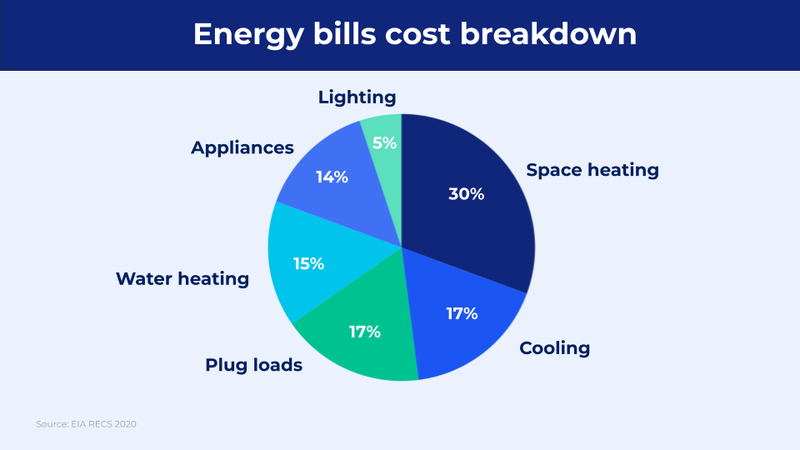
Figure 1. Breakdown of heating and cooling costs for the average US home.
The EPA estimates that homes could reduce heating and cooling costs by 15% by installing air sealing measures and by adding insulation to attics and crawl spaces. The exact savings depend on the home's current condition, climate, and the quality of the improvements installed.
Measuring air leakage
Each home has a different level of air leakage. In general, older homes tend to have more air leakage because of aging materials and outdated construction methods.
The amount of air leakage in a home can be measured through a blower door test. During a blower door test, a fan is temporarily installed in an exterior doorway to create a pressure difference between the inside and outside of the home. This allows professionals to measure how much air enters through unintended gaps and cracks.
One measurement used during blower door testing is Equivalent Leakage Area (ELA). ELA represents the combined size of all air leaks in a home expressed as the equivalent size of a single opening. A higher ELA indicates more air leakage and a greater opportunity for air sealing improvements.
Blower door tests can help identify where air is escaping and determine which building envelope improvements are likely to provide the greatest energy savings.
Improve building envelope first
For homes considering heating and cooling system upgrades, it is often beneficial to improve the building envelope before replacing the equipment. By reducing heat transfer and air leakage, the home may require a smaller heating and cooling system to maintain comfortable indoor temperatures.
Installing appropriately sized equipment after improving the building envelope can reduce upfront equipment costs, improve system performance, and lower long-term energy consumption.
The following sections explore the major components of the building envelope and the upgrades that can improve their performance, including foundations, roofs, insulation, windows, and doors.